The Fireplace That Watched Me Grow Up
Last week, I drove back to my parents’ house in Westfield, New Jersey, the same quiet tree-lined street where I learned how to ride a bike, scraped my knees on the sidewalk, and somehow managed to believe that every problem in the world could be solved by dinner time. I make this drive about once…
Last week, I drove back to my parents’ house in Westfield, New Jersey, the same quiet tree-lined street where I learned how to ride a bike, scraped my knees on the sidewalk, and somehow managed to believe that every problem in the world could be solved by dinner time.
I make this drive about once a month, sometimes more if work lets me.
I pulled onto Hillside Avenue just before noon, parked under the same old maple tree, and noticed immediately that the front windows were open even though it was still cool out.
That alone told me something was going on.
My parents only open windows in early spring when a project is underway, usually one that involves dust, stubborn opinions, and a level of optimism that ignores common sense.
I stepped inside and called out, “Mom?” once, then again a little louder, and then a third time because habits from childhood never really leave you. No answer.
I could hear movement coming from the living room, the scrape of something heavy being shifted, followed by my father muttering under his breath in a tone that suggested a screw had just rolled somewhere inconvenient.
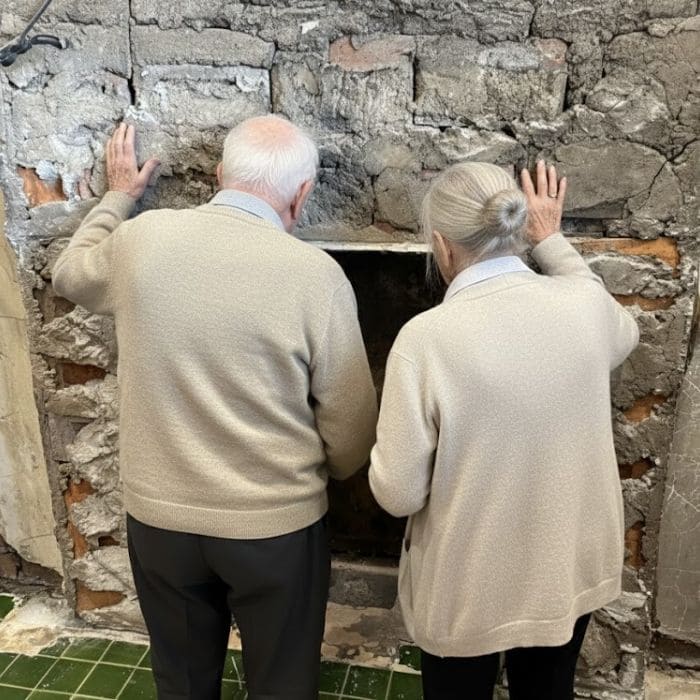
When I rounded the corner, I found them both standing in front of the fireplace, sleeves rolled up, tiles stacked on the floor, and the hearth looking like it had just survived a small but determined battle.
A Fireplace Older Than All of Us
That fireplace has been there longer than anyone currently alive in my family. The house was built in 1924, a solid, practical home with just enough decorative detail to feel proud without trying too hard.
The fireplace sits at the center of the living room, framed originally with deep green ceramic tiles that were fashionable in the 1920s and 30s, paired with a simple brick firebox and a modest wood mantel.
As a kid, I never thought much about it.
It was just there, quietly doing its job during winter, crackling when my mother lit a fire on cold evenings, or standing dark and cool during the summer months while toys crept dangerously close to its edge.
Looking at it now, stripped back to raw brick and uneven mortar, I realized how much history had passed in front of it without anyone really acknowledging its role.
The Problem No One Wanted to Talk About

Over coffee at the kitchen table, she explained what had been happening. For years, the tiles around the firebox had been loosening one by one.
At first, it was just a hollow sound when you tapped them. Then a hairline crack appeared. Eventually, one tile shifted just enough that it caught her eye every time she walked past.
“It wasn’t dangerous yet,” she said, stirring her mug slowly, “but fireplaces don’t fix themselves, and pretending they will is how houses win arguments.”
She told me the real issue was moisture. Somewhere behind the tile, old mortar had begun to fail, likely from decades of heat cycles combined with humidity that no one noticed until it became obvious.
The fireplace insert they added years ago was still sound, but the surrounding structure needed attention before it turned into a bigger, more expensive problem.
My father nodded in agreement, adding that once they removed the first few tiles, it was clear they couldn’t just patch it.
The old adhesive had crumbled, and the brick behind it was uneven, patched over at least twice before.
Pulling the Tiles Off, One by One
When I leaned closer to the fireplace that morning, I could see exactly where the work had begun.
The left side of the surround was already stripped back to bare brick, and the green ceramic tiles that had framed the opening for decades were stacked carefully on an old drop cloth, each one numbered lightly in pencil on the back by my father.
My mom told me they started the night before with the most basic test. My dad tapped each tile gently using the wooden handle of a small hammer, listening for changes in sound.
The hollow ones revealed themselves immediately. Some gave a dull thud instead of the sharp ceramic ring they should have had, which meant the adhesive behind them had failed years ago.
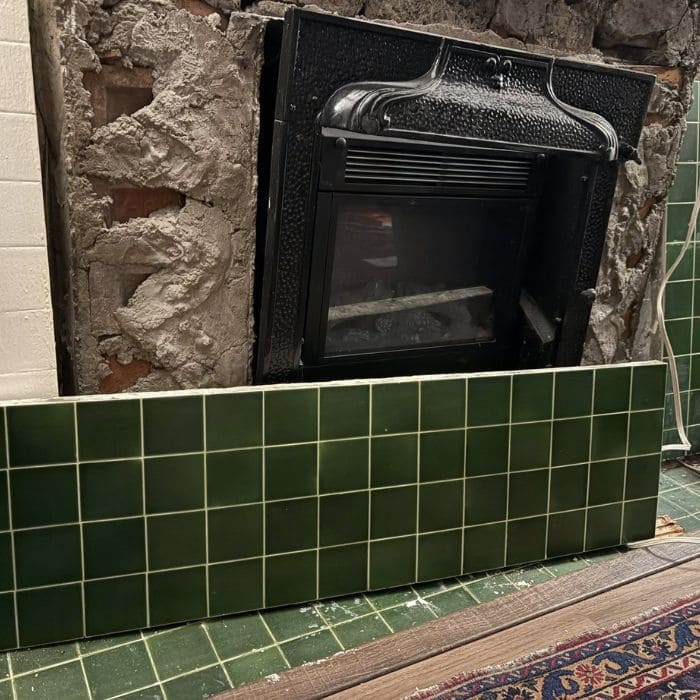
He used a wide masonry chisel, not the sharp kind you’d use to break tile aggressively, but a flatter one meant to slide behind the ceramic without shattering it.
A small rubber mallet followed, tapped lightly, almost politely, as if asking the tiles for permission to let go.
Some came off cleanly, still holding bits of old mortar like dried clay on the back. Others fought back, cracking despite every effort to save them.
My mom said the hardest part wasn’t the physical work, but knowing when to stop.
Once a tile resisted too much, they left it alone and moved to the next one, because forcing it would pull brick with it. Old fireplaces punish impatience.
Under the tiles, the reality of the problem became clear. The mortar bed was inconsistent, thick in some places, powdery in others.
In a few spots, someone decades earlier had clearly attempted a repair using whatever was on hand.
My dad found traces of what looked like plaster mixed with sand, which explained why moisture had eventually worked its way through.
Discovering What Was Still Worth Saving
As more tiles came off, they laid them out in rows on the floor, wiping each one gently with a damp cloth. The color varied slightly from tile to tile, something I had never noticed before.
Some leaned more olive, others deeper forest green, with a soft gloss that only comes from age, not factory perfection.
That’s when the debate started. My mom admitted that part of her wanted to reuse them all, to put everything back exactly the way it had been, but reality stepped in.
Nearly a third of the tiles were chipped or cracked beyond reuse, and several had warped slightly from heat over the years.
“Even if we saved them,” she said, “they wouldn’t sit flat anymore.”
The Search for Matching Green Ceramic
They didn’t give up immediately. Over the next few days, my mom went down a rabbit hole that anyone who owns an old house will recognize instantly.
She took photos of the tiles in natural light, measured them precisely with a steel ruler, and wrote down everything that mattered: 4-by-4 inches, glazed ceramic, slightly rounded edges, uneven thickness, and a color that sat somewhere between moss and bottle glass.
She started locally. A small architectural salvage yard outside Cranford had bins of old tile, but nothing close enough to blend without looking obvious.
Then she tried tile showrooms, where polite salespeople offered modern equivalents that were inspired by vintage, which was code for smooth, perfect, and completely wrong.
My dad made calls too. He remembered a supplier from years ago who specialized in reproduction materials for historic homes.
That lead eventually brought them to a small tile studio in Pennsylvania that still did short production runs using traditional glazing methods.
The samples they mailed were close, but not exact. Under daylight, the color was slightly too cool. Under the lamplight, it went flat.
That’s when my mom made the call that surprised even her. Instead of forcing a match that would always feel off, she decided to let the old tiles retire with dignity.
Repairing the Structure Beneath
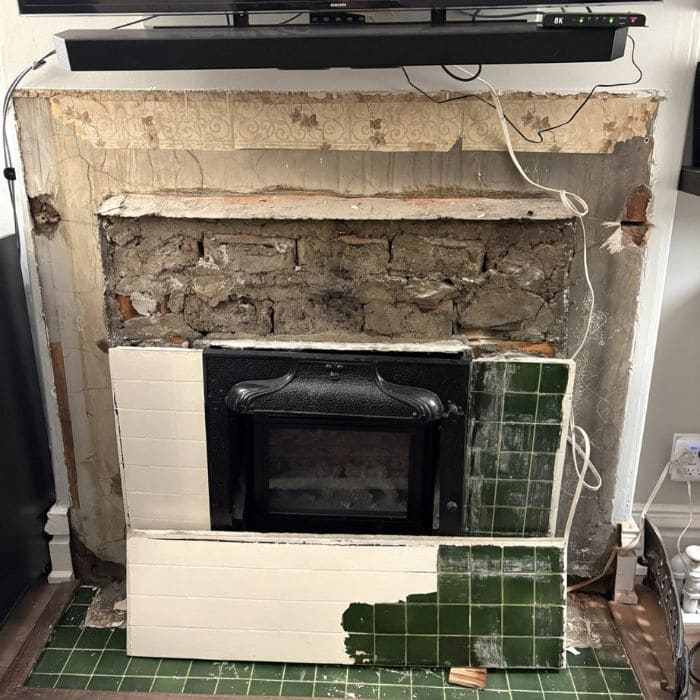
With the tile decision settled, they made the fireplace sound. My dad spent hours cleaning the brick with a wire brush and shop vacuum, removing loose debris without damaging the original masonry.
He mixed new mortar in small batches, matching the softness of the old material so the brick could still expand and contract naturally with heat.
My mom handled the finishing work. She feathered the surface carefully, smoothing but not erasing the subtle irregularities that told the fireplace’s story.
Once everything healed, they applied a masonry primer, followed by multiple thin coats of heat-safe white paint, sanding lightly between layers.
What the Fireplace Became
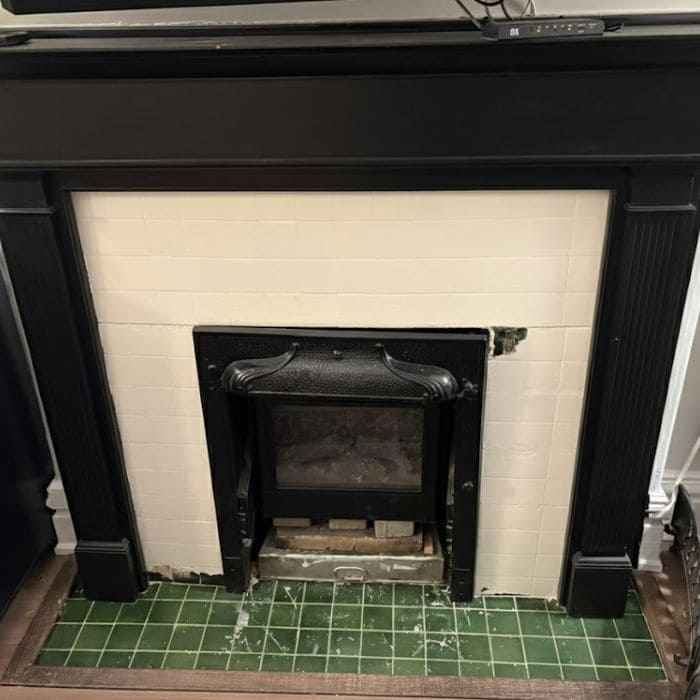
When they finally stepped back, the transformation was quiet but powerful. The white surround reflected light differently now, especially in the afternoon when sun filtered through the front windows.
The black insert stood out cleanly. The mantle felt grounded again, no longer competing with aging tile that had already given everything it had.
My mom ran her hand along the edge and said, almost to herself, “This feels finished.”
Why This Fireplace Matters
Standing there with them, I realized it warmed the room when my parents were newly married. It glowed softly during holidays when relatives filled the house.
When my mom stood back and finally smiled at the finished result, she said, “Now it feels like the house can breathe again.”
And she was right. The fireplace simply exists, steady and reliable, which somehow feels more meaningful than decorative perfection ever could.