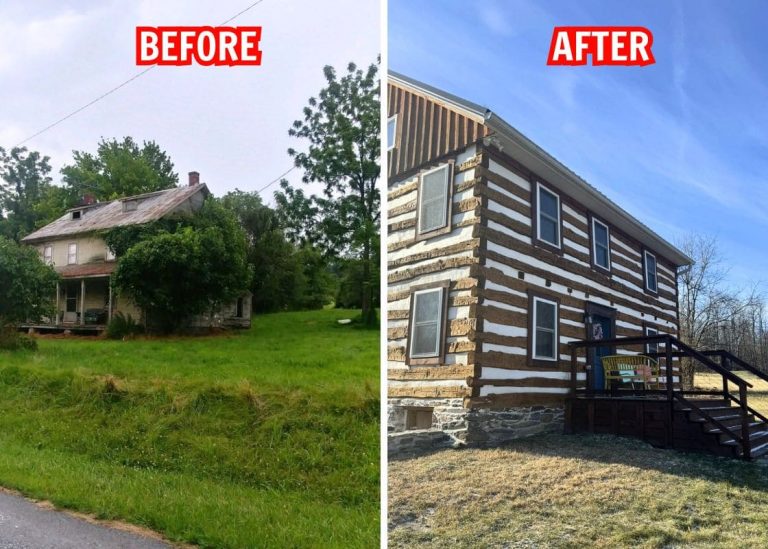
Stepping Beyond the Cottage and Into Drake Hall
If you have been following my recent posts and lingering with me inside modest cottages and quiet houses built for comfort rather than spectacle, then let me pause you right here at the threshold. This is where the scale changes, where restraint gives way to intention, and where architecture stops whispering and starts speaking in…
If you have been following my recent posts and lingering with me inside modest cottages and quiet houses built for comfort rather than spectacle, then let me pause you right here at the threshold.
This is where the scale changes, where restraint gives way to intention, and where architecture stops whispering and starts speaking in full sentences.
I want to open the door to Drake Hall at Bradley Gardens, a house that does not apologize for its grandeur and never pretends to be anything smaller than it is.
I came here after years of writing about homes meant for daily life. I almost did not expect this place to stay with me the way it did.
But once you stand in its 1909 entry hall, trimmed in the finest grade of Honduras mahogany, you understand that some houses are not just lived in. They are composed.
How I Came to Drake Hall

I arrived at Drake Hall through the introduction to the owner years ago, long before I ever saw the house.
We met during a long-term financial advisory project that required patience, discretion, and months of conversations that wandered far beyond numbers.
Gradually, I learned that he collected things most people never notice anymore: early industrial maps, pre-war ledgers, and architectural drawings rescued from demolished estates.
He lives quietly for someone whose name appears on corporate filings and international philanthropy lists. His wealth is not theatrical. It is controlled, deliberate, and deeply tied to preservation.
When he eventually mentioned Drake Hall, it was not with pride but with responsibility.
He said, almost offhandedly, that the house had survived because someone had cared enough not to modernize it into submission.
The Origins of Drake Hall at Bradley Gardens
Drake Hall was completed in 1909 at the edge of what was then a newly planned garden district known as Bradley Gardens, an area designed to attract industrialists who wanted proximity to the city without surrendering privacy.
The house was commissioned by Charles Everett Drake, a railroad equipment magnate whose wealth was tied to steel, timber, and transport infrastructure spreading across the eastern and southern United States.
Drake insisted on materials that were already becoming rare even at the time.
The Honduras mahogany used throughout the entry hall, stair surround, and pocket doors was imported before restrictions tightened, selected for its density, uniform grain, and ability to hold deep polish without filler.
Local craftsmen worked alongside European-trained woodworkers, and records show that the interior millwork alone took nearly eighteen months to complete.
The Entry Hall as a Statement
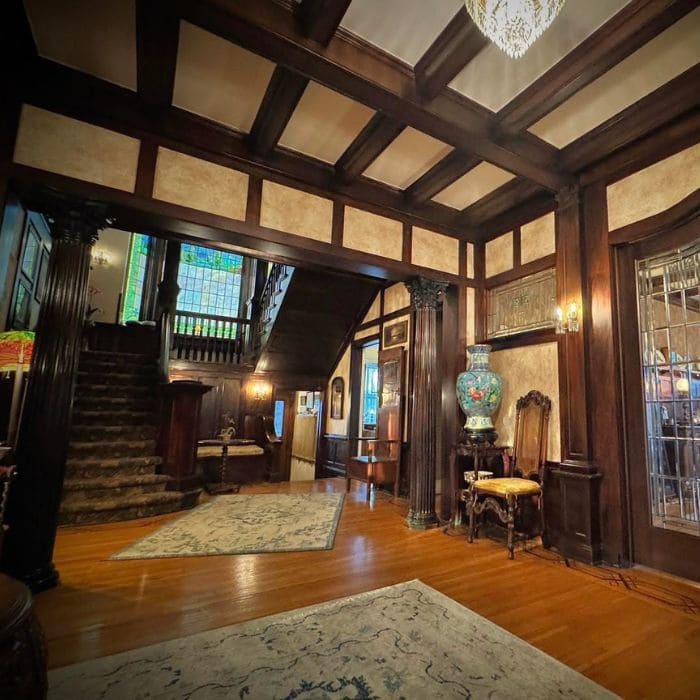
The entry hall is not a transitional space. The moment you step inside, your eyes are pulled upward by the coffered ceiling, each beam wrapped in dark mahogany with lighter plaster infill panels that catch and soften the chandelier’s glow.
The proportions are intentional. Nothing is decorative without purpose.
Underfoot, the floor transitions subtly from the exterior threshold to polished hardwood laid in long runs that emphasize length rather than width.
The central rug anchors the space but never competes with the architecture.
Against the walls, the paneling rises to shoulder height before giving way to textured plaster, a technique used to balance warmth and airiness.
Doors That Do More Than Divide
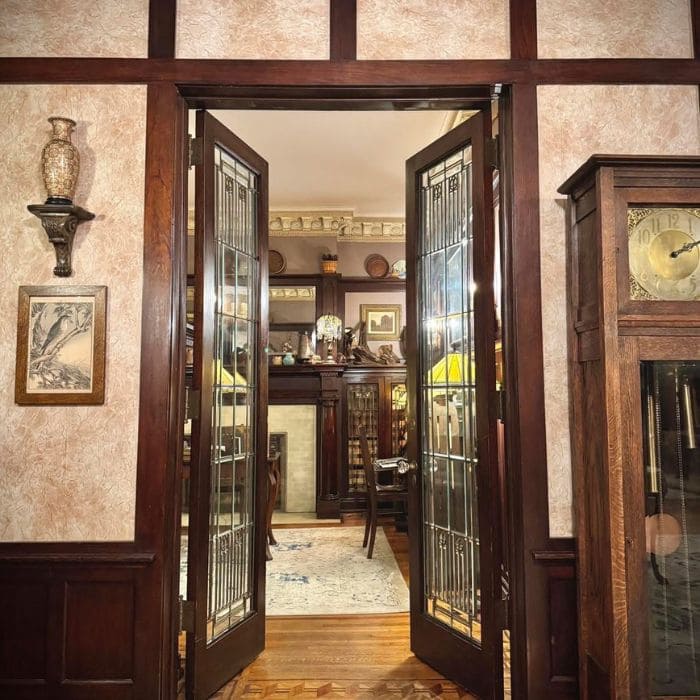
Directly ahead, the leaded glass pocket doors command attention without shouting. Each pane is hand-cut, assembled into geometric patterns that echo early Arts and Crafts influences while still honoring Beaux-Arts symmetry.
These doors slide with weight and intention, guided by original hardware that still functions because it was never replaced with something lesser.
When opened, they reveal a formal reception room that was once reserved for guests of status.
When closed, they create privacy without isolation, allowing light to pass while sound softens. This was a house designed for social choreography, where movement mattered as much as stillness.
The Staircase and the Art of Arrival
To the left, the staircase rises in a gentle curve rather than a dramatic sweep. Its balustrade is carved with restraint, the posts thick enough to feel grounding in the hand.
Above it, stained glass filters daylight in muted blues and ambers, casting slow-moving patterns that change throughout the day.
This staircase was never meant for haste. Its proportions discourage rushing, encouraging pauses that let you notice the grain of the wood, the wear at the center of each tread, and the way the house reveals itself incrementally.
The Owner’s Philosophy of Preservation
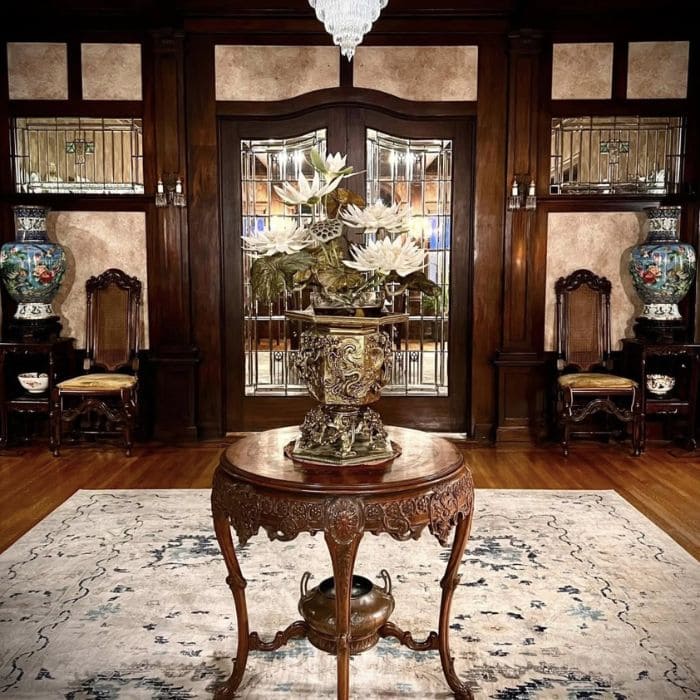
The current owner, now in his late sixties, acquired Drake Hall through a private sale after the house had spent decades under institutional ownership.
Several developers had passed on it, citing restoration costs and impracticality. He saw something else. He saw a complete sentence in a world full of fragments.
Rather than restoring the house to a single imagined moment, he chose conservation. Original finishes were stabilized, not stripped.
Electrical and mechanical systems were updated invisibly, routed through existing chases wherever possible. Modern conveniences were introduced only where they did not demand visual dominance.
Light, Sound, and the Weight of Materials
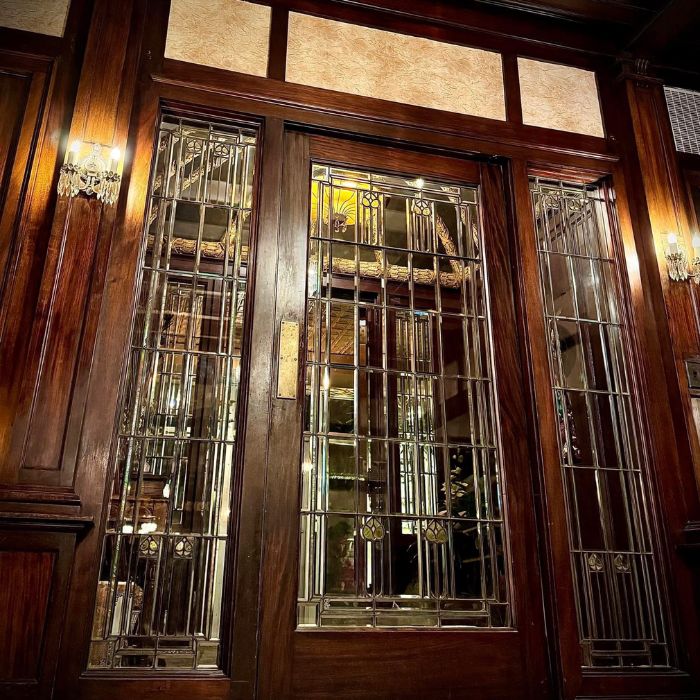
What photographs cannot fully convey is how Drake Hall sounds. Footsteps are softened by the density of the wood. Voices do not echo; they settle.
The mahogany absorbs and reflects sound differently than modern materials, creating an acoustic warmth that makes even quiet conversations feel intentional.
Light behaves differently too. It does not bounce harshly. It glides across surfaces, deepening shadows and highlighting craftsmanship. Even at night, under artificial lighting, the house never feels flat.
Why This House Changes the Conversation
I wanted to bring you here because this house reframes what we think of as luxury.
Drake Hall was designed by people who understood materials deeply and by an owner who respected time as much as space.
If cottages teach us how to live gently, Drake Hall teaches us how to build responsibly, how to let architecture age without apology, and how restraint can exist even within grandeur.