Constraint Becomes the Design for A Small Bathroom
I think many people who follow my work live with bathrooms like this one: narrow, and awkward. Built for a different century, with proportions that make modern remodeling feel almost impossible. This project belongs to one of my customers, but she asked to remain anonymous, and I respected that completely. When I first saw the…
I think many people who follow my work live with bathrooms like this one: narrow, and awkward.
Built for a different century, with proportions that make modern remodeling feel almost impossible.
This project belongs to one of my customers, but she asked to remain anonymous, and I respected that completely.
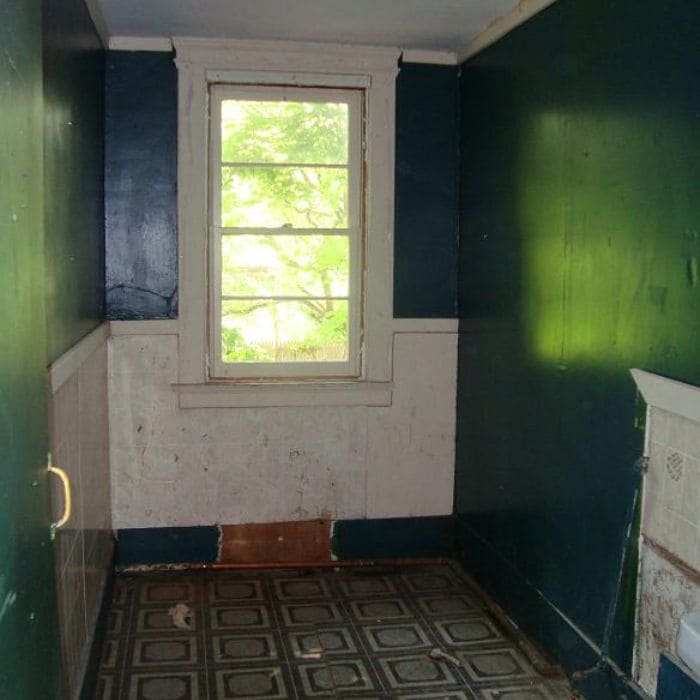
When I first saw the room, it felt more like a passage than a place. Long and tight, with a single window anchoring the back wall and very little flexibility anywhere else.
The floor showed its age immediately, cracked tiles with decades of wear and subtle dips that told the story of an old house settling slowly over time.
The ceiling had clearly endured moisture issues in the past, and the walls felt heavy, not because of their color, but because nothing was working together.
This is the kind of bathroom that makes people freeze. Too small to redesign freely, too old to modernize easily, and too important to ignore.
Looking Back to Move Forward: Finding the Right Inspiration
The turning point came when we stopped asking how to make the bathroom modern and started asking what era it belonged to.
The house itself dates back to the early twentieth century, and while the bathroom had been altered over the years, its bones still spoke clearly.
Narrow rooms, tall ceilings, strong trim details, and proportions that favored verticality over width. Instead of fighting that history, we leaned into it.
The inspiration for this space came from late nineteenth- and early twentieth-century bathing rooms, when bathrooms were not hidden utilities but intentional spaces.
Freestanding tubs, warm metals, layered lighting, and colors borrowed from nature were common then, not as trends, but as necessities for comfort.
Why the Freestanding Tub Changed Everything
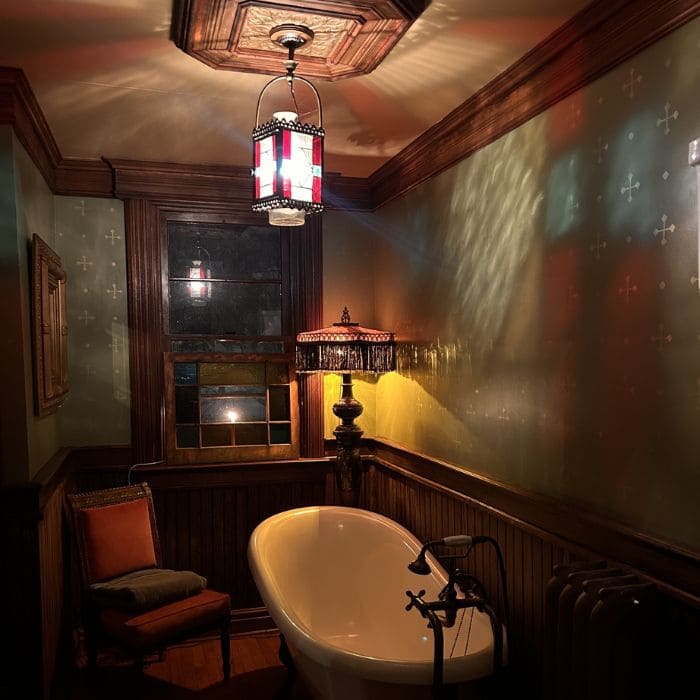
One of the most important design decisions was replacing the bulky built-in tub with a freestanding one.
In a narrow room, built-ins tend to exaggerate width constraints, making the space feel boxed in. A freestanding tub, especially one with a narrower footprint, allows light and sightlines to pass around it.
This choice was not purely aesthetic. It respected the existing plumbing layout, avoided structural disruption, and reduced cost.
But visually, it transformed the room. The tub became a sculptural element rather than an obstacle.
Centered carefully beneath the ceiling fixture, it gave the room a sense of intention that had been missing before.
The faucet choice mattered just as much. A floor-mounted tub filler was selected to keep the walls visually calm. In small bathrooms, wall clutter is the enemy.
Color as Atmosphere, Not Decoration
The wall color was chosen with extraordinary care. A muted, historical green became the foundation of the room, inspired by pigment palettes commonly used in the late Victorian and early Arts and Crafts periods.
This was not a trendy green, it was earthy, slightly moody, and deeply calming.
Green works exceptionally well in small bathrooms because it recedes visually while still offering warmth. It also pairs beautifully with natural wood, aged metals, and soft lighting.
The satin finish was intentional, reflecting just enough light to keep the room from feeling dim without creating glare.
Layering Light in a Narrow Space
Lighting in this bathroom had to do more than illuminate. It had to soften edges, stretch space, and enhance texture.
A ceiling-mounted fixture with warm light became the primary source, chosen for its ability to cast even illumination without harsh shadows.
The design echoed early twentieth-century forms, grounding the room in its historical context.
Accent lighting was introduced carefully, not to brighten, but to create rhythm.
Light interacts beautifully with the green walls, the wood trim, and the curved surface of the tub, creating a space that feels intimate rather than confined.
Materials That Respect Scale and Age
In small rooms, scale is everything. Oversized tiles would have overwhelmed the floor, so smaller tiles were chosen instead, laid in a straightforward pattern that emphasizes order and calm.
Wood paneling along the lower walls served both functional and aesthetic purposes. It protects against moisture while anchoring the space visually.
Historically, this kind of treatment was common, especially in homes where bathrooms were expected to endure daily use without constant renovation.
The trim, ceiling details, and window casing were preserved and restored rather than replaced.
These elements carry the memory of the house, and removing them would have stripped the room of its soul.
Working With Limitations Instead of Against Them
This bathroom could not be widened. The plumbing stack could not be moved. The window could not be relocated. Accepting those truths early prevented costly mistakes later.
Instead of forcing symmetry where it did not belong, the design emphasized balance.
The tub placement, the lighting alignment, and the visual weight of materials all work together to create harmony within constraint.
Storage was intentionally minimal. In small bathrooms, excess storage often creates visual noise. What remained was carefully integrated and kept low-profile, allowing the room to breathe.
A Space That Feels Timeless
This bathroom is like a space that belongs to the house, to the century it was born in, and to the people who use it now.
If you are staring at your own small bathroom and feeling overwhelmed, I hope this story helps you see possibility instead of limitation.
Sometimes the most powerful designs come not from freedom, but from restraint, respect, and patience.
And sometimes, the smallest rooms teach us the biggest lessons about how to live well inside our homes.