A Stone Wall, Two Knees, and the Kind of Work You Don’t Forget
I have always believed that the best house stories are not the polished ones with perfect lighting and brand-new finishes, but the quiet, stubborn projects that live outside, done slowly. This story came to me the way many good ones do, by accident, over a neighborly conversation that started with a wave and ended with…
I have always believed that the best house stories are not the polished ones with perfect lighting and brand-new finishes, but the quiet, stubborn projects that live outside, done slowly.
This story came to me the way many good ones do, by accident, over a neighborly conversation that started with a wave and ended with a bucket of mortar.
A few months ago, a man moved in two houses down from me. Let’s call him Tom, because that’s his name and he insisted I use it if I was going to tell this story properly.
Tom is the kind of neighbor who notices things, like the way a wall leans just enough to bother you, or how old concrete always tells the truth if you look long enough.
One afternoon, as we stood by the sidewalk looking at the retaining wall that runs along the front slope of his property, he said, almost casually, “I built that when I was fifty-four.”
He paused, stretched his knees, and added with a grin, “I’m sixty-nine now, and I’m not sure my body signed up to do it again.”
How the Wall Came to Be
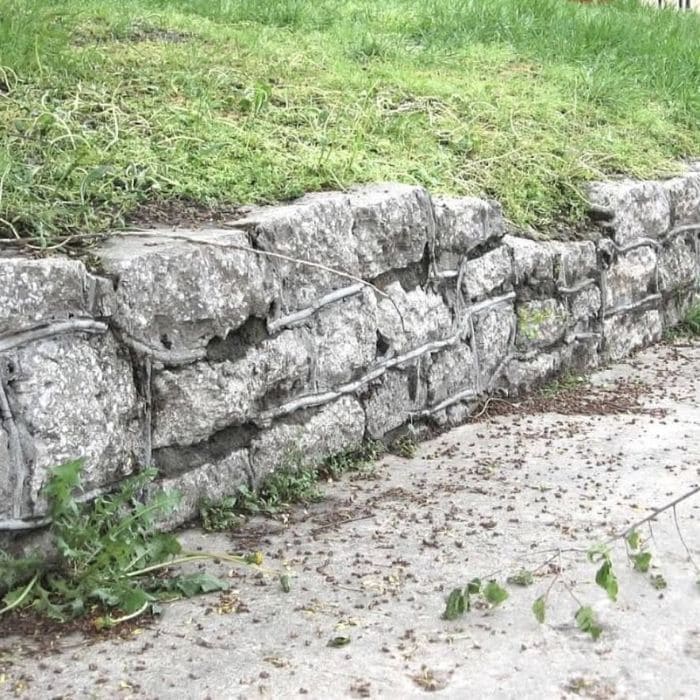
Fifteen years ago, this property looked very different. The front yard slopes down toward the sidewalk at a shallow but persistent angle, the kind that slowly pushes soil forward with every heavy rain.
Back then, the original retaining wall was already failing, with cracked concrete blocks, missing mortar, and stones that had shifted just enough to make everything feel temporary.
Tom didn’t hire it out, he didn’t call a crew. He decided, instead, that he would rebuild it himself, one section at a time, after work and on weekends, because that was how he had always done things.
The first step was demolition, and that turned out to be more physical than he expected. Old concrete does not come apart politely.
Using a cold chisel, a three-pound mason’s hammer, and a lot of patience, he broke apart the failed sections, stacking reusable stone to one side and hauling broken rubble into a wheelbarrow that made more trips to the dumpster than he cares to count now.
Some of the stones weighed close to fifty pounds, and every one of them had to be lifted, lowered, and set by hand.
Mixing Mortar the Old Way
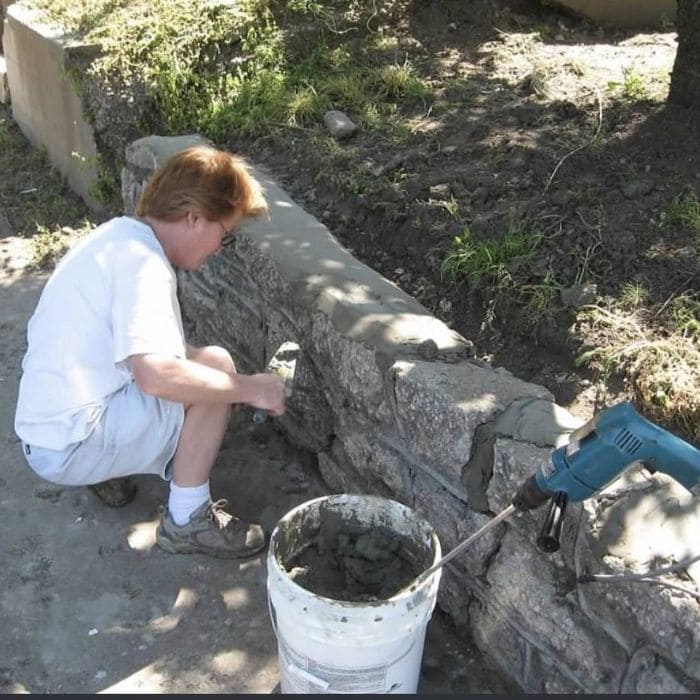
There is a white five-gallon bucket on the sidewalk, half full of mortar, and a blue corded drill fitted with a paddle mixer that looks like it has seen better days.
That drill was plugged into an extension cord running back to the garage, and Tom remembers exactly how long he could mix before the motor started to smell warm and complain.
The mortar itself was a basic Type N mix, chosen because it was forgiving enough for an older stone wall and allowed a little flexibility as the ground moved.
Each batch had to be mixed carefully, not too wet, not too dry, because once it was on the wall there was no fixing it without starting over.
He worked in sections no longer than four feet at a time, laying stone, checking level, buttering joints, and striking the mortar by hand with a small jointer so the finish would match the older stone nearby.
The Hardest Part Was the Squatting
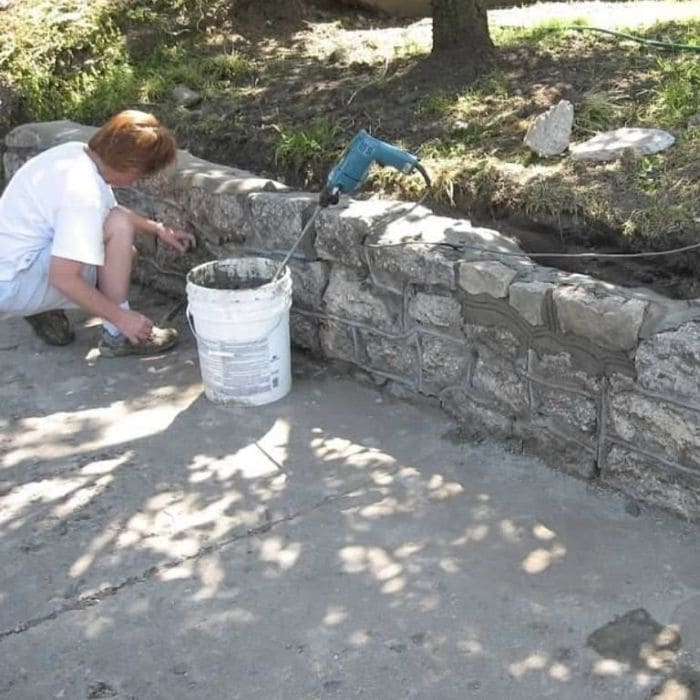
When people talk about projects like this, they often focus on strength, but Tom will tell you the real challenge was endurance.
Squatting for hours, knees bent, weight shifting back and forth as stones were set into place, was something his body could handle at fifty-four, even if it complained at night.
He worked with knee pads at first, then without, then back with them again when he realized pride does not protect cartilage.
By the end of each day, he says, his hands were stiff, his shoulders burned, and his legs felt like they belonged to someone else entirely.
Still, the wall rose steadily, course by course, the lines tightening, the stones locking together in a way that only happens when you take your time.
When Things Went Wrong
Not everything went smoothly, and Tom is quick to admit that. One section near the steps had to be torn down and rebuilt after a heavy rain washed out freshly set mortar overnight.
Another time, he misjudged the angle of the cap stones and had to pull them off before the mix cured, resetting the entire top row.
Those moments are visible if you know where to look, tiny variations in stone alignment and mortar thickness that tell the story better than perfection ever could.
He also discovered old steel reinforcement buried in the original wall, rusted and useless, which had to be cut out carefully with a reciprocating saw before new stone could be placed.
Fifteen Years Later
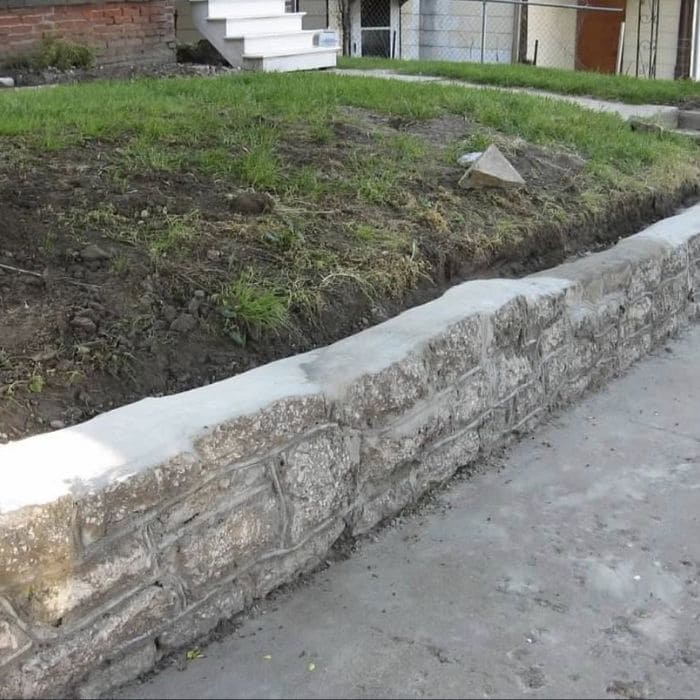
Today, the wall still stands, straight and solid, doing exactly what it was meant to do. Grass grows above it evenly, the sidewalk below remains clear, and most people walk past without giving it a second thought.
Tom, however, sees every joint.
He knows which stones were the hardest to set, which section took the longest, and where he would do things differently if he had to start again. He also knows that time has caught up with him in small, undeniable ways.
“I can still do the repairs,” he told me, looking at the wall one afternoon, “but I’m going to take more breaks, and I’m definitely bringing a stool this time.”
This Story Matters
This is why I wanted to share this project on my blog, because houses are not just roofs and kitchens and curb appeal.
They are quiet records of effort, patience, and decisions made by people who cared enough to do the work themselves.
Fifteen years from now, someone else may patch a joint in this wall, never knowing who set the stones or mixed the mortar, but the wall will still be there, holding back the earth, doing its job with no need for recognition.
And if you ever find yourself looking at an old retaining wall and thinking about fixing it, remember this story, remember the bucket, the drill, the knees that once bent easily, and the satisfaction that comes from building something meant to last longer than you do.