A Room Built for Time, Not Trends
An Impressive Living Room for Anyone I couldn’t resist sharing these two images I recently saved from Instagram.The living room, in particular, feels like a space that understands time. The first thing that defines this living room is its vertical scale. The height of the ceiling immediately establishes a sense of openness, but what keeps…
An Impressive Living Room for Anyone
I couldn’t resist sharing these two images I recently saved from Instagram.The living room, in particular, feels like a space that understands time.
The first thing that defines this living room is its vertical scale. The height of the ceiling immediately establishes a sense of openness, but what keeps it from feeling cold or overwhelming are the exposed wooden beams.
These beams are not decorative gestures; they act as visual anchors, pulling the eye back down into the room and giving it weight.
Dark-stained wood was historically used this way in European and early American homes to create intimacy within large volumes, and that logic still works today.
The furniture arrangement is equally deliberate. Seating is placed in a balanced, inward-facing layout that encourages conversation rather than performance. No piece dominates the room.
Instead, each chair and sofa participates in a shared rhythm, which is essential in large living spaces where isolation can easily creep in if furniture is pushed too far apart.
Upholstery in soft greens and muted blues keeps the palette grounded and calming, while patterned cushions add variation without noise.
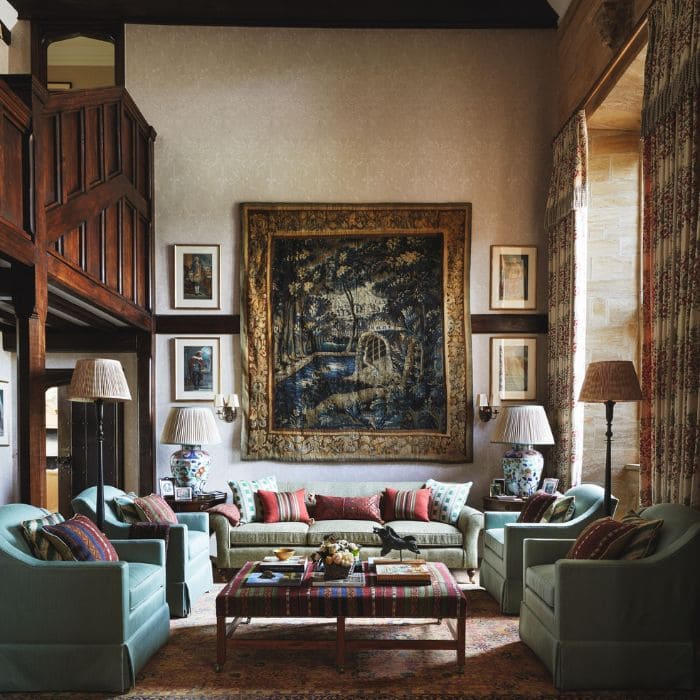
What truly anchors the room, though, is the tapestry. Large-scale textile wall art has a long history in grand homes, serving both aesthetic and practical purposes.
Beyond its visual impact, a tapestry absorbs sound, softens acoustics, and brings warmth to expansive walls that might otherwise feel bare or echo-prone.
Here, it functions as the emotional center of the room, quietly drawing attention without demanding it.
Lighting is handled with restraint and intelligence. Instead of relying on a single overhead fixture, the room uses table lamps and floor lamps placed at human height.
This creates pools of warm light that make the space feel livable in the evening, which is when living rooms truly earn their purpose.
Large rooms often fail because they are only designed to look good in daylight. This one is clearly meant to be used after sunset.
Everything about this living room suggests longevity. The materials look chosen for how they will age, not how they will photograph on day one.
This is a room meant to hold conversations, silences, books, and people over decades.
A Dining Room That Honors Gathering
If the living room is about lingering, the dining room is about gathering, and it wears that purpose confidently.
The long dining table immediately establishes scale and intent, but what stands out is how much space remains around it.
Circulation has been respected, which is critical in homes designed to host many people. Chairs can be pulled out, servers can move freely, and the room never feels compressed.
The walls do most of the storytelling here. Mural-style landscapes wrap the room in continuity, creating a sense of enclosure without heaviness.
This approach draws from classical European interiors where dining rooms were often immersive spaces, meant to transport guests somewhere beyond the walls.
The color palette stays soft and natural, allowing the artwork to feel expansive rather than overwhelming.
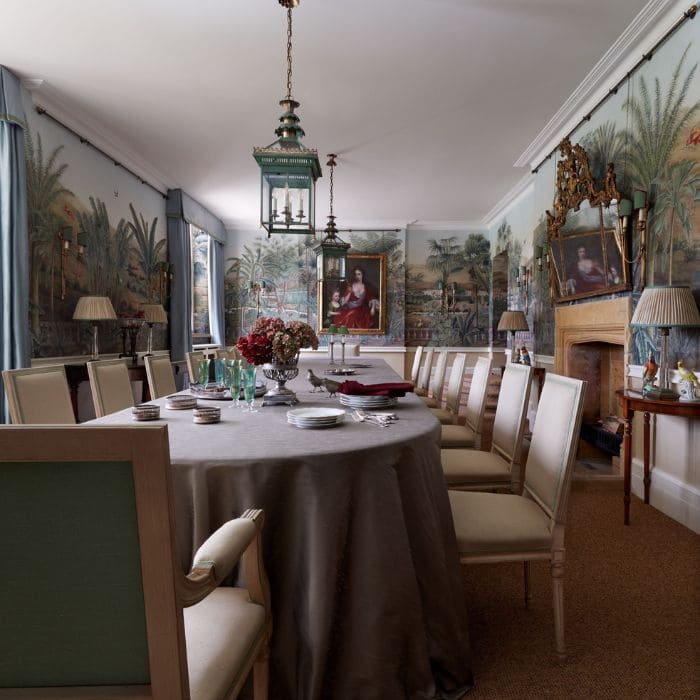
Lighting again plays a crucial role. Hanging lantern-style fixtures provide structure along the length of the table, while additional lamps and sconces soften the perimeter of the room.
This layered approach ensures that no one sits in shadow, and that the room remains comfortable during long meals.
It also avoids the common mistake of relying on a single dramatic chandelier, which often looks impressive but performs poorly in practice.
The furniture itself leans toward classic proportions rather than strict historical reproduction. Chairs are upholstered for comfort, acknowledging that meals here are not rushed affairs.
Table linens are substantial, adding texture and improving acoustics, which is often overlooked in large dining rooms where sound can bounce harshly off hard surfaces.
The fireplace reinforces the sense that this room exists for shared moments.
It suggests warmth, ritual, and continuity, reminding us that dining rooms were once the heart of the home, not just formal spaces reserved for special occasions.
Caring for a Home with Large Rooms and Many Lives Inside
Homes of this scale require a different mindset when it comes to care.
Maintenance is less about perfection and more about consistency. Large rooms magnify both beauty and neglect, so routines matter more than occasional deep efforts.
Zoning is essential. Each room should have a clear purpose, and every piece within it should support that purpose.
When large spaces lack definition, they tend to collect objects that don’t belong anywhere else. Rugs, lighting, and furniture placement all help reinforce boundaries within a room, making it easier to maintain order.
Material choice is another key factor. In homes meant to accommodate many people, finishes should be chosen for resilience and repairability.
Wood that can be re-oiled, fabrics that can be cleaned without fear, and metals that develop a natural patina all allow a home to age gracefully.
Cleaning routines benefit from being broken into small, regular tasks. Dusting architectural details like beams, moldings, and artwork weekly prevents buildup that becomes overwhelming later.
Floors should be protected with well-placed rugs that absorb wear while still allowing the original surfaces to breathe.
Lighting maintenance is often overlooked but deeply important. Keeping bulb temperatures consistent across fixtures preserves the mood of a room.
In large spaces, mismatched lighting quickly disrupts harmony and makes rooms feel disjointed.
Most importantly, a large home must be allowed to live. These rooms were designed to hold people, not to remain untouched.
Chairs should be moved, tables should show signs of use, and spaces should evolve with the family that inhabits them.