How Much Do You Pay to Live In A Space Like This?
ADVERTISEMENT Knock, knock, knock… Even though I have not worked directly in real estate for a long time, I still carry the habit of reading a house the way an inspector, a designer, and a future occupant would all at once. ADVERTISEMENT A few friends and I make it a point to visit architect-designed homes…
Knock, knock, knock…
Even though I have not worked directly in real estate for a long time, I still carry the habit of reading a house the way an inspector, a designer, and a future occupant would all at once.
A few friends and I make it a point to visit architect-designed homes and high-end model houses whenever we can, because these spaces often reveal where residential design is quietly heading before it becomes mainstream.
This house did not feel staged for sale, it felt settled.
Site and Placement: Architecture That Responds Instead of Dominates
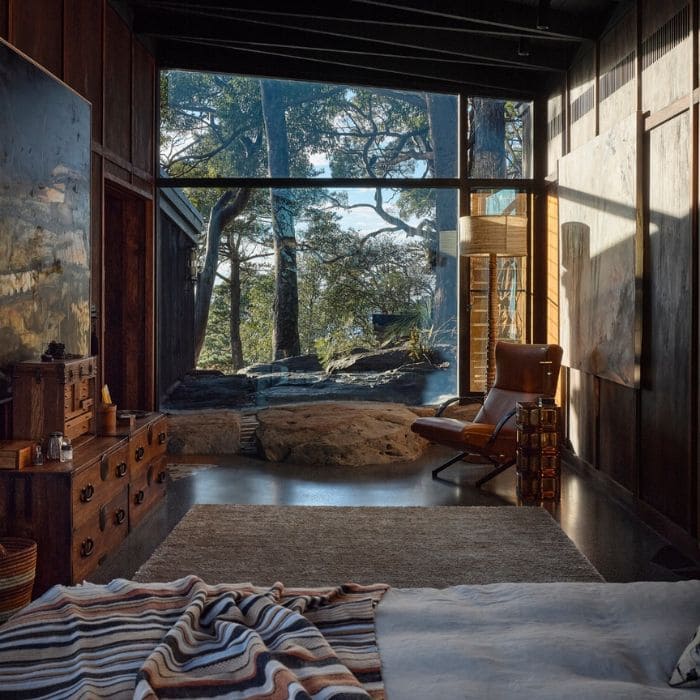
The first thing that becomes clear is that the house was designed specifically for this plot of land, not adapted afterward.
The structure sits low and horizontal, hugging the terrain instead of rising above it, which immediately tells you the architect prioritized environmental integration over visual drama.
Mature trees surround the building on at least two sides, likely preserved intentionally during construction, and the distance between the glass façade and the nearest tree line appears calculated to balance privacy, light filtration, and seasonal shading.
Based on the exposed stone, the shallow foundation depth, and the way the interior flooring aligns with exterior rock shelves, this site likely has shallow bedrock, which often complicates construction and increases cost.
Instead of blasting it flat, the design embraces the irregularity, using stone walls as both structural and aesthetic elements.
Architectural Language: Mid-Century Modern Reinterpreted, Not Reproduced
While the house clearly draws from mid-century modern architecture, it avoids imitation.
You see the influence in the flat roof planes, exposed beams, and strong horizontal lines, but the detailing is more restrained, closer to Japanese modernism than American optimism.
There are no decorative trims, no unnecessary moldings, and no ornamental gestures that do not serve a purpose. Every visible joint, seam, and transition is intentional.
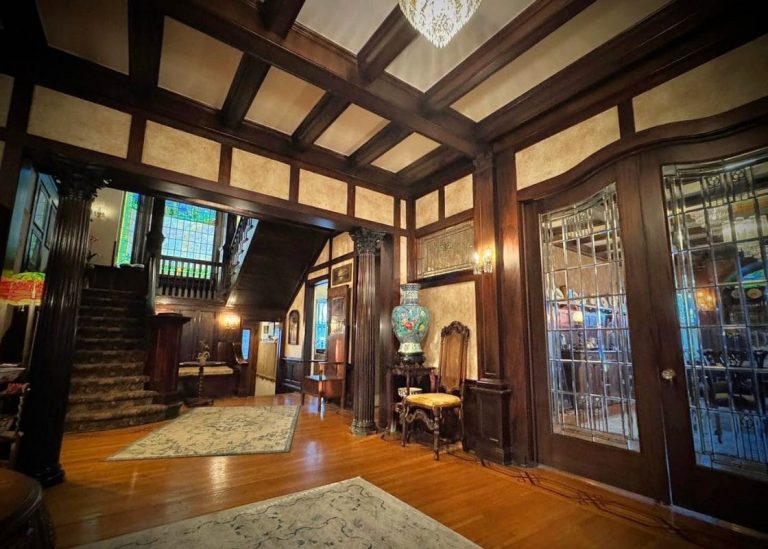
Wood paneling is continuous and uninterrupted, suggesting custom millwork rather than modular panels, and the ceiling beams are structural, not decorative, which is increasingly rare in contemporary builds.
Entry Sequence: Compression Before Release
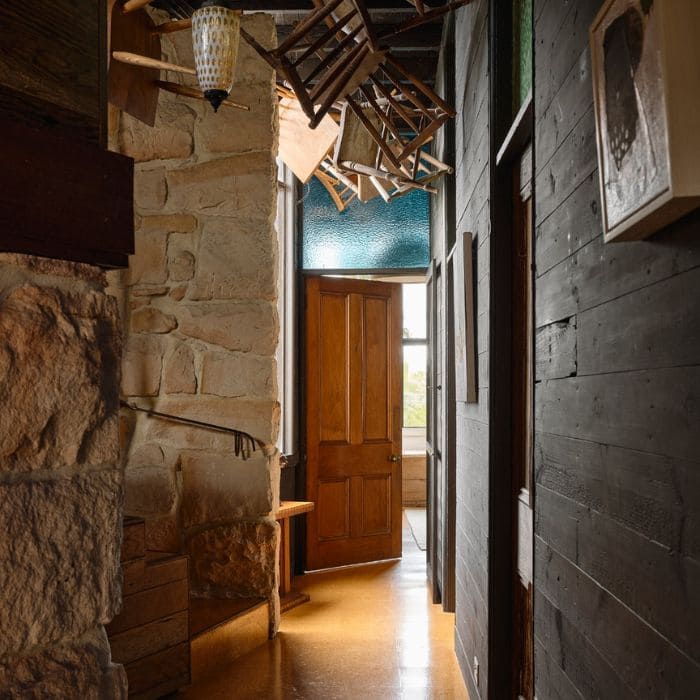
Rather than opening immediately into a large space, the entry guides you through a narrow corridor with darker finishes and lower perceived ceiling height.
This is a classic architectural technique used to heighten spatial awareness, and it works particularly well here.
The stone walls are load-bearing, not veneer, with visible variations in texture that confirm they were laid by hand rather than manufactured.
Lighting is indirect and warm, likely recessed or wall-washed, keeping glare to a minimum and encouraging your eyes to adjust gradually.
The suspended chair installation overhead, while visually striking, also reinforces the idea that this house is willing to challenge expectations without sacrificing coherence.
Living Room: Designed for Human Scale, Not Furniture Catalogs
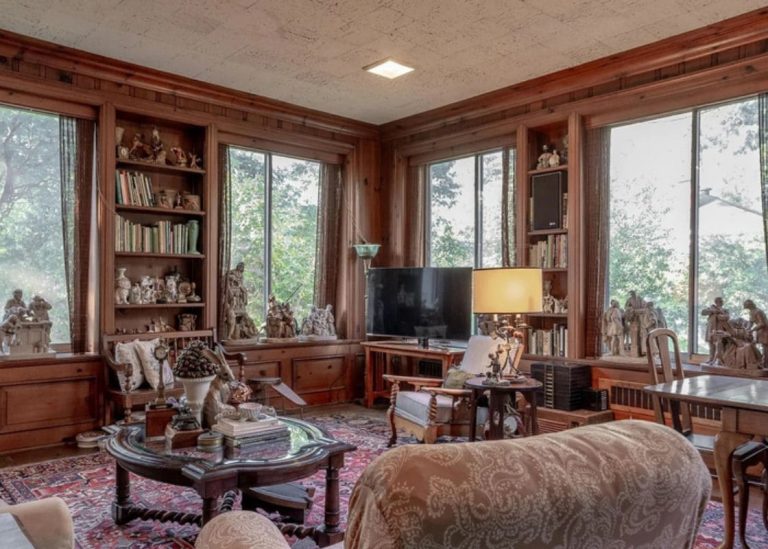
The living room feels expansive without being oversized, between 450 and 550 square feet, which allows for multiple seating arrangements without making the space feel cavernous.
Ceiling height appears modest by luxury standards, possibly 9 to 9.5 feet, but the exposed beams add depth and rhythm rather than height for height’s sake.
The glazing system spans nearly wall-to-wall, but the glass itself is likely triple-pane or high-performance double-pane, given the size and climate considerations.
Frames are minimal and dark, visually receding so the view becomes the focal point rather than the architecture.
The terrazzo or polished concrete floor continues uninterrupted from room to room, which not only simplifies cleaning and maintenance but also reinforces visual continuity and thermal mass, helping regulate indoor temperature naturally.
Kitchen: Professional Logic Disguised as Simplicity
The kitchen is where the house reveals how seriously it takes daily use.
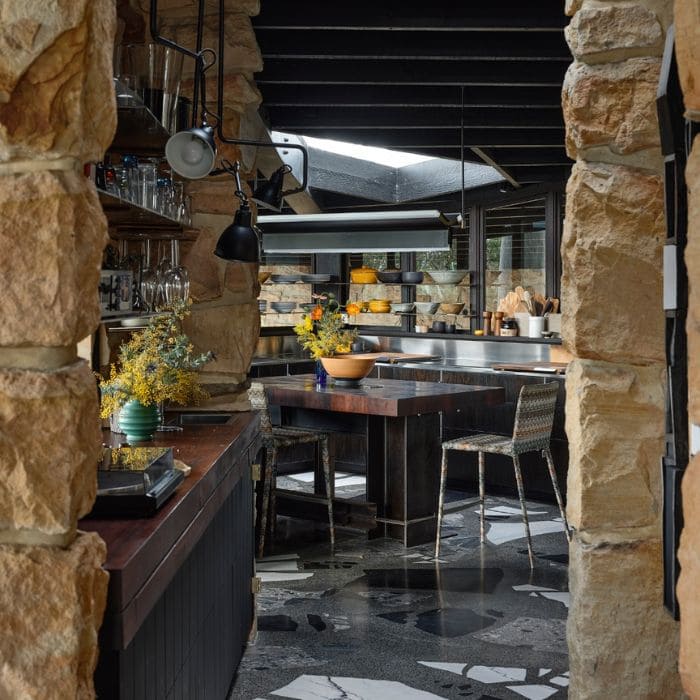
The terrazzo flooring is poured-in-place, not tile, with a large aggregate mix that adds durability and hides wear over time. This is significantly more expensive than tile but far more forgiving in the long run.
Cabinetry is concentrated below counter height, finished in dark-stained hardwood that conceals fingerprints and wears better than lighter finishes.
Open shelving replaces upper cabinets entirely, reducing visual bulk while encouraging thoughtful organization.
The island, likely weighing several hundred pounds, is topped with solid wood rather than stone, which is a deliberate choice that prioritizes warmth, repairability, and tactile comfort over trendiness.
Overhead, a large skylight delivers direct daylight to the prep zone, reducing reliance on artificial lighting and improving circadian rhythm alignment throughout the day.
Dining Area: Integrated, Informal, and Honest
The dining area does not announce itself as a separate room. Instead, it exists as a natural extension of the kitchen, reinforcing the idea that eating is part of daily life, not a formal performance.
The table is solid wood, likely custom, sized to seat four comfortably while accommodating six when needed. Chairs are lightweight but textured, balancing the visual heaviness of the table and floor.
Bathrooms: Small Footprints, High Function
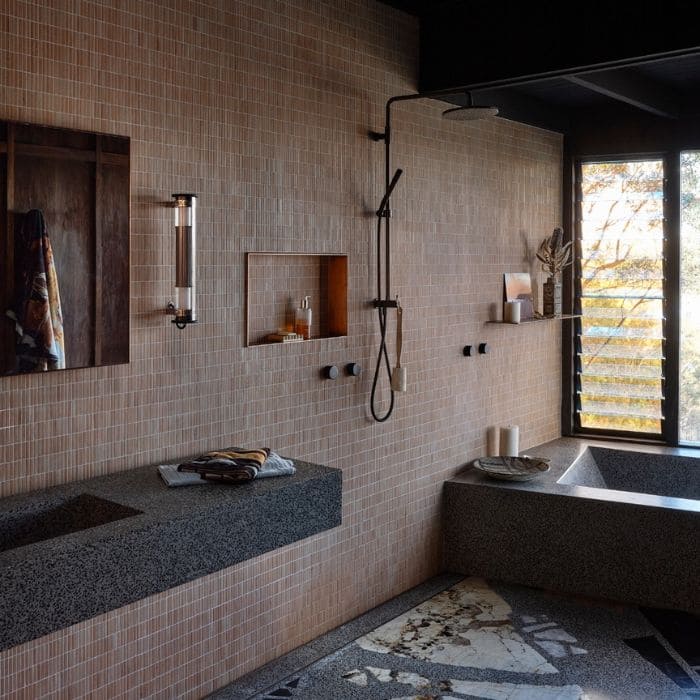
Bathrooms in this house are intentionally compact, likely under 80 square feet, but every decision maximizes usability.
Small-format ceramic tiles are used instead of large slabs, which allows walls to breathe visually while reducing cracking risk over time.
Built-in niches replace shelving, and wall-mounted fixtures free up floor space while simplifying cleaning.
Lighting is layered, combining soft ambient sources with targeted illumination near mirrors and vanities.
Bedrooms: Quiet Spaces Meant to Adapt
Bedrooms are modest in size, likely 120 to 150 square feet, but feel larger due to minimal built-ins and sliding wood partitions instead of hinged doors.
This saves swing space and allows rooms to open up visually when doors are retracted.
Windows are carefully placed rather than expansive, prioritizing privacy and thermal efficiency. Flooring remains consistent throughout the home, reinforcing continuity and reducing acoustic transitions.
These rooms are designed to evolve with their occupants rather than dictate how they should be used.
Cost and Value: Beyond Square Footage
A home like this likely exceeds $500 to $700 per square foot in construction cost alone, depending on location, labor market, and material sourcing.
Custom millwork, poured terrazzo, structural stone, and high-performance glazing all add significant expense.
But this house is not about size or resale theatrics.
It is about living with materials that age well, spaces that adapt quietly, and design choices that reduce the need for constant updates.