One Radiator Stays Cold in the Middle of Winter
ADVERTISEMENT It had been bitterly cold in New Jersey for weeks,and on that particular morning the temperature outside hovered around five degrees. When I went upstairs to the third floor, where my home office is located, the rooms felt noticeably cooler than the rest of the house. ADVERTISEMENT At first I didn’t think much of…
It had been bitterly cold in New Jersey for weeks,and on that particular morning the temperature outside hovered around five degrees.
When I went upstairs to the third floor, where my home office is located, the rooms felt noticeably cooler than the rest of the house.
At first I didn’t think much of it because uneven temperatures are something you come to expect in older homes, especially those that were expanded and altered over many decades.
What made me pause wasn’t just the chill, but the absence of warmth where I expected it to be.
All three radiators on that floor were completely cold to the touch, not lukewarm or slow to respond, but fully at room temperature, as if the system simply wasn’t reaching them at all.
This house is still very new to me AS I’ve only owned it for about a month and a half, so I don’t yet have the deep familiarity that comes from years of living with a building and understanding its patterns, and its weaknesses.
The heating system here is a hot water radiator system, not steam, and it operates on a single zone, which means that when the thermostat calls for heat, every radiator in the house should respond together.
With that in mind, I went back downstairs and raised the thermostat to force a call for heat, expecting to hear the subtle changes that usually follow when hot water begins circulating through old iron radiators.
Bleeding the System and Finding the Outlier
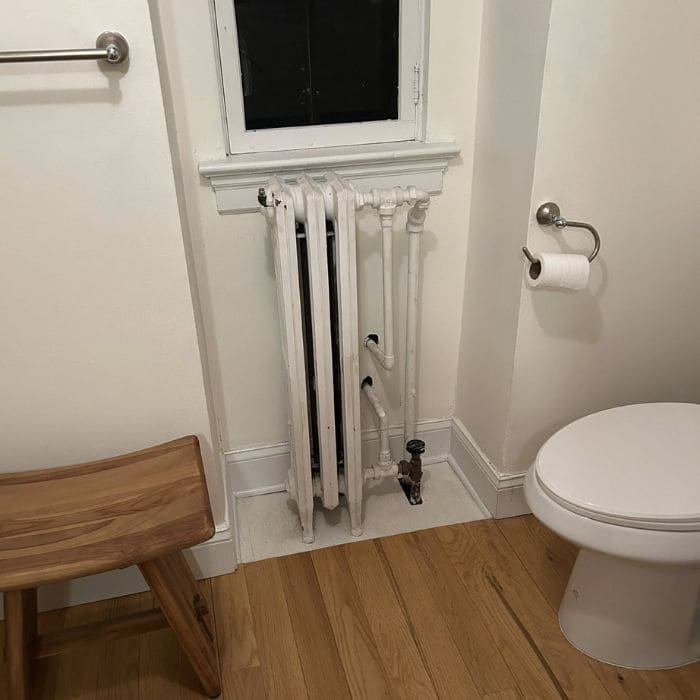
The next step was the most obvious one, and one that anyone familiar with hot water radiators eventually learns to do almost instinctively: bleeding air from the system.
I started with the two radiators that were easiest to access, opening the bleed valves slowly and listening as a surprising amount of trapped air escaped before hot water followed.
Within moments, both of those radiators began to warm up exactly as they should, confirming that air had been at least part of the problem.
At that point, I expected the third radiator to behave the same way, but it didn’t. When I opened the bleed valve on that unit, there was no hiss of air at all.
Instead, I got a steady stream of water, flowing continuously but at noticeably lower pressure than the others, and that water was cold. The radiator itself remained completely unresponsive.
A Small Bathroom Radiator That Told a Bigger Story
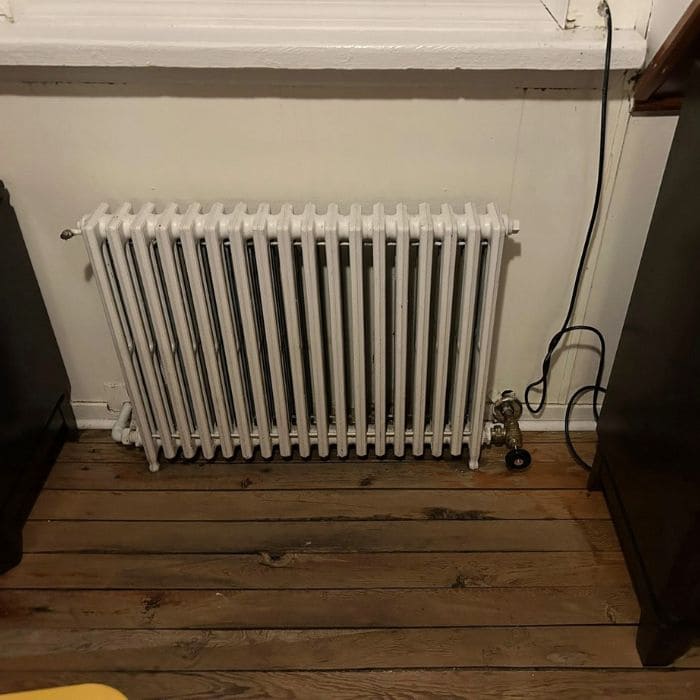
The clue turned out to be hiding in a tiny bathroom adjacent to the bedroom.
Under a small window sat a narrow, older radiator with exposed piping that disappeared into the wall in a way that immediately raised questions.
Following the path of those pipes as best I could, it became clear that this bathroom radiator had been used as a tapping point for an additional radiator installed later, likely when what had once been an unheated attic was converted into living space.
The signs were subtle but unmistakable once you noticed them.
The floorboards in the bedroom appear to be original, unfinished subfloor rather than flooring intended for a conditioned space, and the dormer window looks like a later addition rather than part of the original structure.
The piping appears to run from the bathroom radiator into the attic area, travel roughly fifteen feet around a ninety-degree corner, and then return into the wall to feed the bedroom radiator.
How You Can Have Water but Still Have No Heat
One of the most confusing aspects of this situation, and one that trips up many homeowners, is the fact that water was coming out of the radiator when it was bled, which makes it feel counterintuitive to suspect a circulation problem.
In a hot water system, however, circulation is everything, and pressure alone does not guarantee that hot water is actually moving where it needs to go.
If the supply line feeding a radiator becomes partially frozen or restricted, especially in a long, narrow pipe run through an unconditioned space, hot water may not be able to move forward into the radiator at all.
At the same time, water can still move backward or sideways through the return line when a bleed valve is opened, creating the illusion that everything is connected and functioning normally.
In a deep cold, pipes don’t always freeze solid. Sometimes they develop a slushy blockage that is just enough to stop circulation without causing an immediate rupture, which is both a blessing and a source of confusion.
Why This Radiator Failed When the Others Didn’t
Several factors worked against this particular radiator, and none of them are uncommon in older homes.
It sits at the far end of the system, which means it already receives hot water last, and any resistance in the system will affect it first.
The pipes feeding it likely pass through attic or knee-wall spaces where insulation may have shifted or deteriorated over time, allowing cold air to wash directly over the lines during extreme weather.
Compounding the issue, this radiator had no trapped air, which meant bleeding alone could never restore heat.
This wasn’t about removing air pockets; it was about restoring circulation through a vulnerable section of pipe.
The Quiet Fear of Frozen Pipes
Anytime freezing is suspected, the unspoken fear is the same: a cracked pipe hidden somewhere behind walls or floors.
In this case, there were no immediate signs of failure.
System pressure remained stable, there were no visible leaks, and there was no sudden drop in boiler pressure, all of which suggested that if ice was present, it hadn’t yet caused catastrophic damage.
Partial freezes often resolve without ruptures once warmth is restored, but they should never be ignored, especially in a system you’re still learning.
What I Did Next and Why It Matters
The most important decision I made was to leave the thermostat calling for heat, because shutting the system down would only prolong the cold conditions in the pipes.
I focused instead on warming the suspected pipe runs, opening any access points near the bathroom radiator and attic knee walls and carefully introducing supplemental heat to raise the ambient temperature around the pipes.
The goal wasn’t to blast heat aggressively, but to gently and safely allow any ice restriction to melt so circulation could resume naturally.
Feeling the pipes confirmed the suspicion: the return line was slightly warmer than the supply, indicating that hot water simply wasn’t making it through the loop.
This was a circulation problem, not an air problem, and understanding that distinction made all the difference.
Preventing a Repeat in the Future
Once heat is restored, the next steps are clear. The pipes feeding that radiator need proper insulation, especially in attic spaces where temperature swings are most extreme.
Air leaks around dormers and knee walls should be sealed, because moving cold air can be more damaging than cold temperatures alone.
Long term, the correct solution would be to repipe the bedroom radiator directly into the main loop rather than feeding it through the bathroom radiator, eliminating the extended run through cold spaces altogether.
And finally, the attic itself, including the unexpected raccoon guest, needs attention, because displaced insulation and open cavities create ideal conditions for frozen pipes.