The Attic Parapet I Still Carry With Me
ADVERTISEMENT I took these photos in late September of 2004, on a residential street just east of Court Street in downtown Kingston, New York, not far from Forsyth Nature Center and the old trolley route. I know the season because the maple leaves along the sidewalk had just started turning, and we kept brushing them…
I took these photos in late September of 2004, on a residential street just east of Court Street in downtown Kingston, New York, not far from Forsyth Nature Center and the old trolley route.
I know the season because the maple leaves along the sidewalk had just started turning, and we kept brushing them off our sawhorses every morning before work.
This house had already lived a long life by the time we arrived. Built in 1891, it sat among other Queen Anne-era homes, though this one still retained more of its original massing and proportions than most.
It had been carefully maintained, but like many houses of its age, it had lost details one renovation at a time, especially above the second floor where fewer people ever bothered to look.
The attic dormer was the first thing that caught my attention, even before I met the homeowner.
The Photograph That Changed the Scope of the Job
The homeowner, David, had lived there for about eight years when we met.
He worked in historic preservation law and had a habit of digging into archives for fun, which is how this project even became possible.
He showed me the photograph on our second site visit.
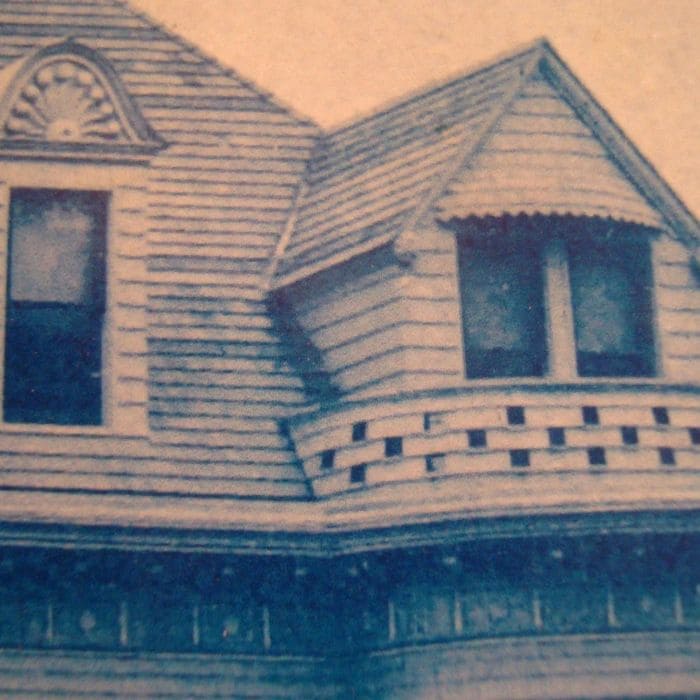
It was a small, slightly warped print he had ordered from the Ulster County Historical Society, dated approximately 1902-1905 based on the siding and window profiles visible elsewhere in the image.
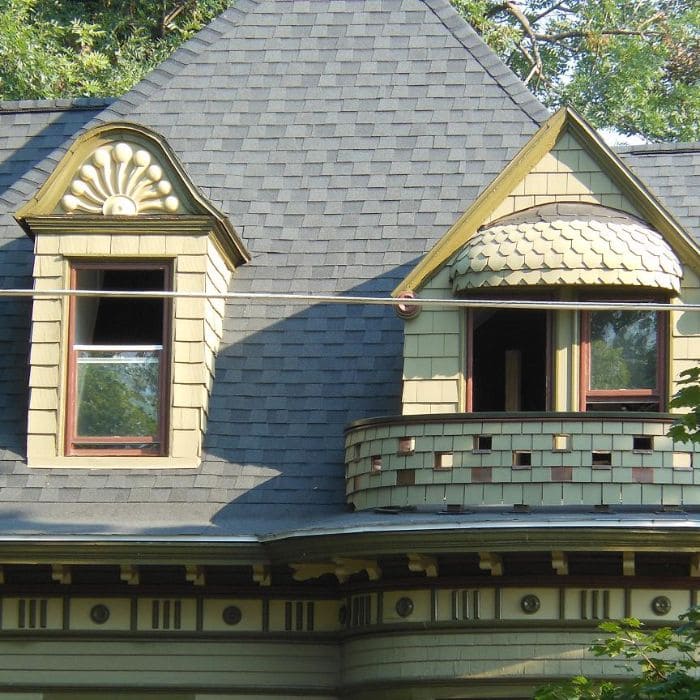
The dormer parapet was unmistakable. A curved, basket-like form wrapping the base of the dormer windows, pierced with small square openings and capped with a darker material that contrasted with the painted shingles below.
By 2004, it had been gone for nearly 100 years, likely removed during a roof replacement sometime between 1915 and 1925, judging by nail patterns we later found in the sheathing.
David asked casually, “Do you think it’s even possible?”
I said without fully thinking it through, “Yes, but only if we’re willing to do it the hard way.”
Standing on the Sidewalk and Making the Call
A week later, I drove back alone early one morning, parked across the street, and stood on the sidewalk with the photograph in my hand.
That mattered to me because this detail was designed for distance, for the human eye moving down the street.
Without the parapet, the dormer looked abruptly cropped, almost temporary. With it, the roofline made sense again.
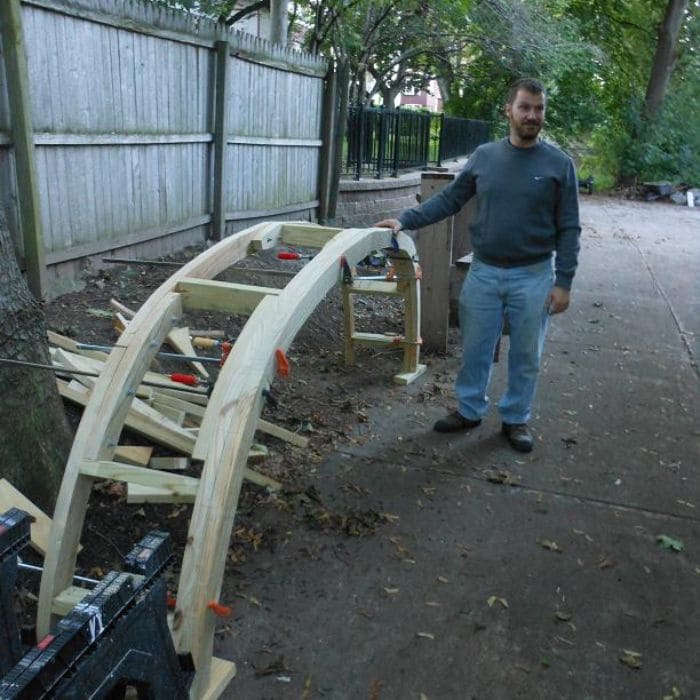
I didn’t build this alone, and I want that to be clear.
My coworkers on this project were Mark Reynolds, Luis Ortega, and Tom Wilcox, all of whom I worked with regularly at the time.
Mark handled layout and curve geometry, Luis oversaw material prep and joinery, and Tom focused on historical accuracy and integration with existing elements.
We worked out of a small rented shop space off Route 32, but most of the parapet was built directly in the backyard because the curve was too large to transport fully assembled.
Reconstructing a Shape With No Drawings
Using the photograph, Mark scaled the parapet based on known dimensions, including the dormer window width and the exposure of the fish-scale shingles below.
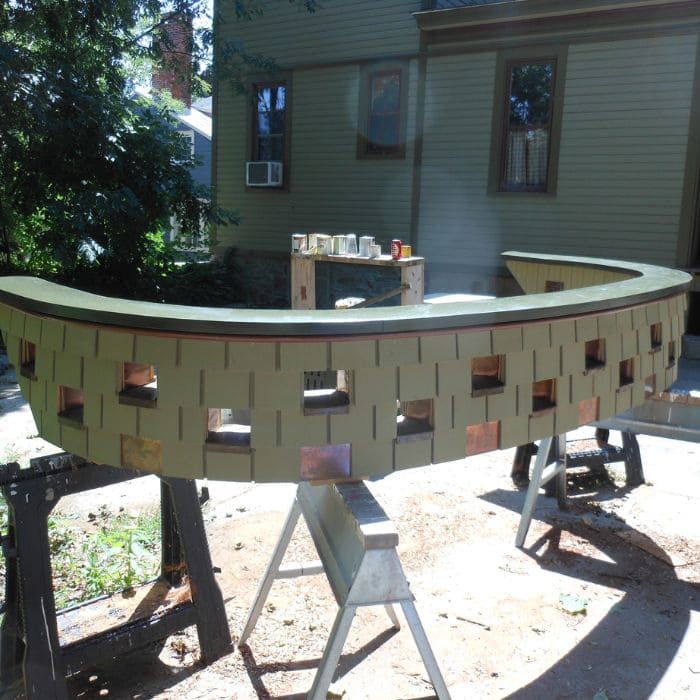
We estimated the parapet height at just under 18 inches, with the cap extending roughly 2¼ inches beyond the face.
The curve wasn’t a perfect semicircle. It flattened slightly toward the center, something you wouldn’t notice unless you were looking for it, but something that would feel wrong if ignored.
We laminated clear pine for the structure, bending it incrementally over several days using clamps and custom forms.
Any attempt to rush the bend caused splitting, which forced us to slow down and respect the material.
Why African Mahogany Was Chosen
Historically, it may have been chestnut or old-growth pine, neither of which was realistically available.
We chose African Mahogany because of its density, stability, and resistance to rot without chemical treatment.
We sourced it from a specialty lumber yard in Newburgh, NY, rejecting several boards before selecting stock with straight grain and minimal internal stress. Each piece was milled, dry-fitted, then shaped by hand.
By the end, we were jokingly calling it the toilet bowl because of its shape, but none of us treated it lightly. We all knew this piece would define the project.
Installation Day and Controlled Chaos
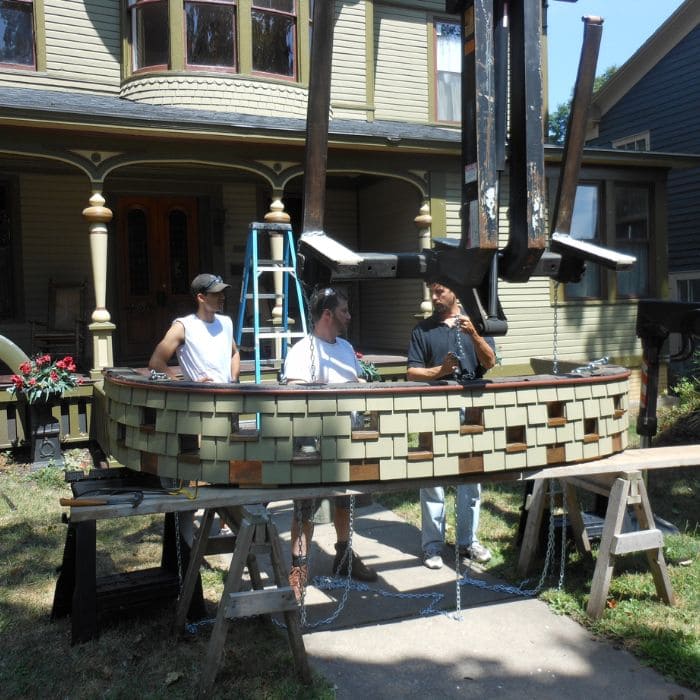
Installation took place over two full days. We assembled the parapet in three sections on the ground, lifted using chain hoists and temporary bracing.
The roof pitch made balance tricky, and we paused multiple times to recheck alignment.
At one point, a sudden gust shifted one section just enough to make all of us freeze.
Once secured, the parapet was flashed, sealed, and painted in a muted green matched to other trim elements on the house.
Then, I stepped back across the street, stood where I had weeks earlier, and looked up. The dormer no longer felt unfinished.
Honestly I Never Deleted These Photos
I’ve worked on dozens of old houses since then, some larger, some more complex. But this project stays with me.
That African Mahogany cap is still there today. I drove past the house last summer and slowed down without even thinking about it.
Some projects don’t need to be remembered by anyone else.
But I’m glad this one still lives on my phone, waiting for the right moment to be shared with people who understand why details like this matter.